“You don’t need more space. You need less stuff.” ― Joshua Becker, The More of Less: Finding the Life You Want Under Everything
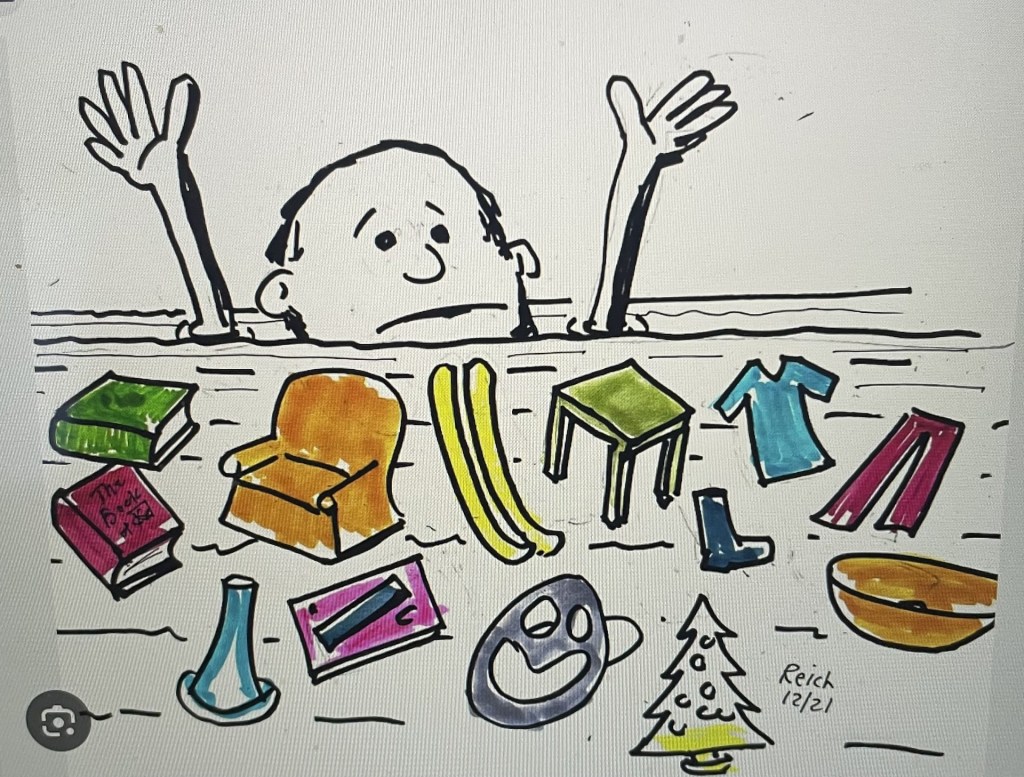
Physical stuff often seems to rule our lives. We have stuff for our homes, our jobs, for travel, and our hobbies. We have our sentimental stuff and the stuff we keep for “just in case”. Sometimes we inherit other people’s stuff. Often we buy bigger stuff in order to better organize and store our smaller stuff. It feels like we need it all, and it’s really hard to part with it. Drive down any major road in the US, and you will see how hard it is to part with stuff by the sheer number of self-storage units. Such units are popping up literally everywhere. But at what point does the keeping of our stuff actually create too much stress and anxiety and, obviously, clutter? When do we acknowledge that hanging on to stuff that is neatly packed away in boxes for “use someday” is not good for our emotional wellbeing? Does holding on to too much stuff hold us back from really living now? And finally, how do we find a healthy balance somewhere between being a hoarder or a minimalist? I know, lots to ponder!
Years ago, the late comedian George Carlin did a bit called “A Place for My Stuff.” He described our homes as no more than covers for our stuff. In his funny and clever way, he posits that the whole meaning of our lives is to sort out places for our stuff and other people’s stuff. While funny, I wonder if being preoccupied with managing our stuff might prevent us from living our lives in the present moment. What are we missing out on because we are too focused on the care and keeping of our material stuff? Living in California close to wildfire areas has forced me to think hard about my stuff and its perceived importance. What would I do if all of it burned? How would that loss change me? What piece or item would I miss the most? In thinking about losing it all in one big catastrophic event, I realized that I was hanging onto a lot of stuff because it felt like it somehow “proved” my life experiences and memories. But I know that my life experiences and memories are mine whether or not I have stuff that proves it. Of course the loss would hurt…a lot, and I would grieve, but the loss of stuff would not, and should not, be the end of me or my life.
Recently, I was helping my stepmom empty out the large home she and my father shared for many years. She’s downsizing into a smaller, two-bedroom in a senior community. Over nearly forty years of marriage, which included lots of travel, she and my dad collected art, ceramics, tons of books, and other treasures. Deciding what to bring and what to let go of was the hardest part for her. Even with clear measurements of the room dimensions (i.e., limited space), it was hard and painful to whittle down which items would fit and be useful, and which needed to be rehomed or sold. I spent nearly a week helping her sort and pack. Each piece has a story, and the story needed to be told for her to make any sort of decision. So many of the items were linked to experiences she and my dad shared. Her grief at losing him was obviously intertwined in the items. Letting them go, I am sure, felt like letting him go all over again. Attachment to stuff helps anchor our memories in time, but we can sometimes get stuck in the past too. Maybe we can do more good for ourselves and others by letting items go so they may find new life beyond a storage box. Here’s an example: my stepmom had a backup coffee pot that she wanted to keep. It held little sentimental value other than being used at many of the big dinner parties she and Dad used to host. I suggested that some starving college student would be thrilled to find this coffee pot for sale at Goodwill. She was then able to let go of the coffee pot because she could picture someone else enjoying it. Then there were the pieces that she was not ready to part with, had no room or need for, but wanted to box/wrap and store. We had numerous conversations around how holding onto the stuff that gets stored away where it is not used, seen, or appreciated is perhaps not the best way to honor the memory or story of those items. The process of sorting and letting go is emotionally difficult for sure.
If we decide we would like to have less stuff, where do we even begin? A few years ago, Marie Kondo seemed to be everywhere. Her “does this spark joy” method of freeing our lives and spaces from too many material possessions was very popular. People bought her book (stuff, by the way) and endeavored to purge and organize their stuff. Kondo’s ethos is centered around the idea that the space we live in should reflect the person we are right now, not the person we were in the past. Oh boy, does this resonate for me. Our material things do not define who we really are. And, as the saying goes, you can’t take it with you. Kondo and other professional organizers suggest that we aim to keep the memories, not the stuff. To do this, we need time to sort and visit with our stuff before we part with it. This can be done by setting up a plan for reviewing our stuff. Break it down into bite-sized pieces with clear start and end dates. For example, clean out one closet on a weekend. Kids’ art or old letters can be photographed or scanned. Items marked for donation or sale should be taken away immediately. This way we are not drowning in boxes of paper and other items. We must be selective in what we save – just the very best or the most important items. As we approach purging our stuff, we should ask ourselves if the item or items are currently serving our lives right now. Another question to think about is whether having all of our treasures stored away in boxes where we can’t easily reminisce or appreciate them is really helpful or healthy for us. Perhaps it might be better for ourselves, others, and the planet if we set some of our stuff free to be used and loved by others?
I am not really a saver. Clutter and stored boxes of stuff stress me out. Sometimes people think because I’m not a saver, I am not sentimental or that I don’t value family history and tradition. Not true at all. I love and treasure the stories of my past, where I came from, and all the iterations and experiences of my life. But, as I have gotten older, I find that drowning in boxes of things from the past distracts me from the present. I can’t really enjoy all that the present and future moments offer if I am encumbered with tons of stuff from the past. In the spirit of full transparency, I do have some boxes of special items from my kids’ and my own childhood, as well as a few treasured items from my parents and grandparents. Periodically, I enjoy a walk down memory lane with each item and decide if I should keep holding on to it. As I said earlier, lots to ponder. Dealing with our stuff is a very personal journey for each of us, but well worth the effort to remember, review, and maybe even let go a little bit.


Leave a Reply